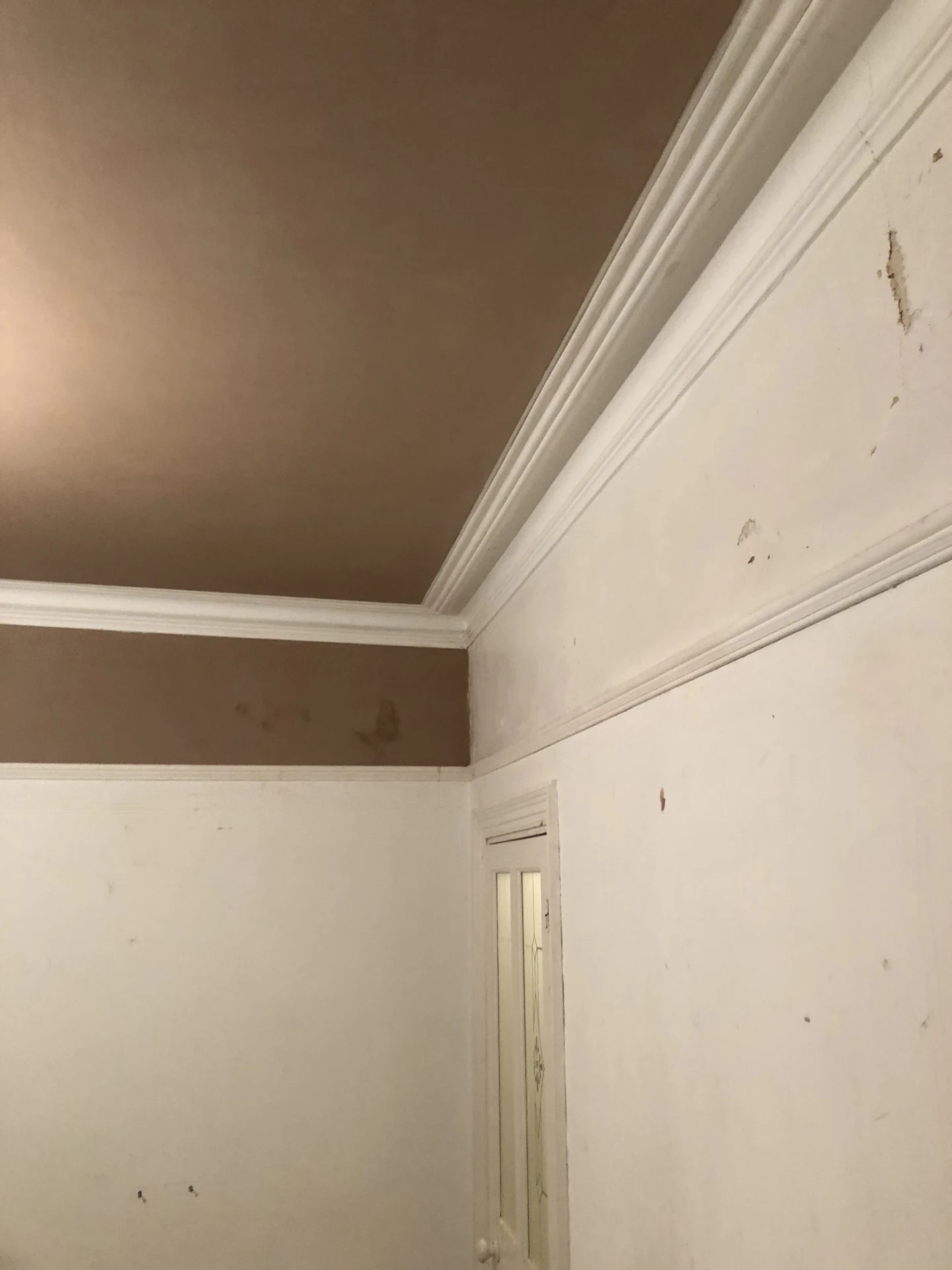
Map the crack around the room
Follow the visible line with your eyes and record where it starts, stops and changes direction. A narrow opening along the top lip differs from a diagonal split through a mitred corner. Note whether the same defect appears on opposite walls or only beside one section. Photographs taken from matching positions over time can help establish whether the appearance is changing, although they cannot by themselves determine whether the underlying building movement is significant.
Look beyond the moulding for related evidence. Staining above the coving may indicate water ingress, while a crack continuing down the wall needs a broader assessment than a detached paint edge. Doors becoming difficult to close or several newly developing cracks are also worth reporting. Do not label every junction crack as settlement: that explanation may overlook an adhesive failure, a leak or movement between materials that needs a more specific response.
Understand the junction between wall and ceiling
Coving bridges two surfaces that do not always move together. Timber ceiling construction can respond to changes in moisture and temperature, while the adjoining wall may behave differently. A small opening may therefore occur at one adhesive edge even though the moulding remains intact. Seasonal recurrence can be useful information, but it does not prove that the section is securely attached or that a flexible cosmetic repair will be appropriate in every case.
The coving material also matters. Plaster mouldings can be substantial and require sound support, while lightweight products have their own adhesive and finishing requirements. A previous repair may have bonded to wallpaper or weak paint instead of a dependable background. Multiple coats of decoration can disguise the original edge and create a brittle bridge across a junction. Establishing which layer has cracked helps avoid removing sound moulding just to repair a failed paint film.
Decide whether the moulding is still secure
Signs of possible detachment include a dropped section, a widening shadow behind the profile or a joint that no longer aligns with the adjacent length. Do not tug, wedge or lever the piece to confirm your suspicion. Heavy plaster coving can fall if its remaining bond is disturbed. Keep the area underneath clear where attachment is doubtful and arrange an assessment of the moulding and its backing, rather than standing below it to attempt a temporary fill.
The assessment should consider both contact edges, the condition of the wall and ceiling coatings and any damage caused by moisture. A repair may involve securing or replacing a section after unsuitable material has been addressed. The correct adhesive and any supplementary fixing depend on the product and background. Random screws through a decorative profile can damage it, miss the support or encounter concealed services, so they are not a universal cure for a separating cornice.
Repair the right layer and preserve the profile
A fine, stable gap at the edge of securely attached coving may suit a compatible paintable flexible product. The joint must be prepared in accordance with that product's instructions, with failing decoration dealt with appropriately. A split through a rigid plaster moulding may need a different repair to restore its shape. Filling every defect with the same tube of caulk can leave soft ridges across crisp details and will not reattach a loose length.
Take care when preparing the ceiling alongside the moulding. Pre-2000 artex may contain asbestos; do not sand or scrape it, and arrange an accredited laboratory test before disturbing a suspect textured coating. Once the surrounding materials are established as safe, keep any preparation controlled so the profile is not flattened. Check compatibility between repair material, primer and finish paint, and consider decorating to a corner or another natural stopping point rather than leaving a conspicuous patch.
When to call a plasterer about coving cracks
Seek a plasterer's view when a crack passes through the moulding, corner joints repeatedly separate or the profile needs rebuilding to match neighbouring lengths. Suspected detachment calls for assessment of how the coving is supported, not just a decorative estimate. If the crack is accompanied by continuing water ingress or signs of wider movement, arrange the relevant investigation first. A neat moulding repair cannot resolve a leaking roof or determine the structural significance of changing wall cracks.
When enquiring, supply a room view, a photograph of the affected corner and a close image that shows which edge has opened. Mention whether the coving is plaster or a lightweight product if known, without breaking a piece off to identify it. Stephen O'Brien has 25 years' experience. To discuss the plastering aspect, call 07852 191811, Mon-Sat 7:30am-6:30pm, and explain whether you need a local junction repair or assessment of damaged decorative plasterwork.
More about this topic
Is a thin line above coving always structural?
No. It may involve paint, the adhesive edge or relative movement at the wall and ceiling junction. However, width alone does not establish the cause. Changing cracks, displacement or associated defects should be assessed rather than dismissed because the opening initially looks small.
Can I fill a corner joint without removing the coving?
Possibly, if both lengths remain firmly attached and the reason for the opening has been considered. A displaced or repeatedly separating mitre needs more than surface filling. The chosen repair should preserve the corner shape instead of building an obvious mound over it.
Why does the same crack appear each winter?
Seasonal changes can affect the materials meeting at the junction, but recurring cracks can also reveal an inadequate earlier repair or a weak bond. Record the pattern and have the attachment checked before assuming that seasonal timing makes the defect harmless.
Will painting over the line keep it closed?
Paint does not provide meaningful support across an opening joint. It may temporarily conceal a very fine mark, but the film can split again if movement continues. First distinguish a paint defect from a gap requiring compatible filling or a moulding requiring refixing.