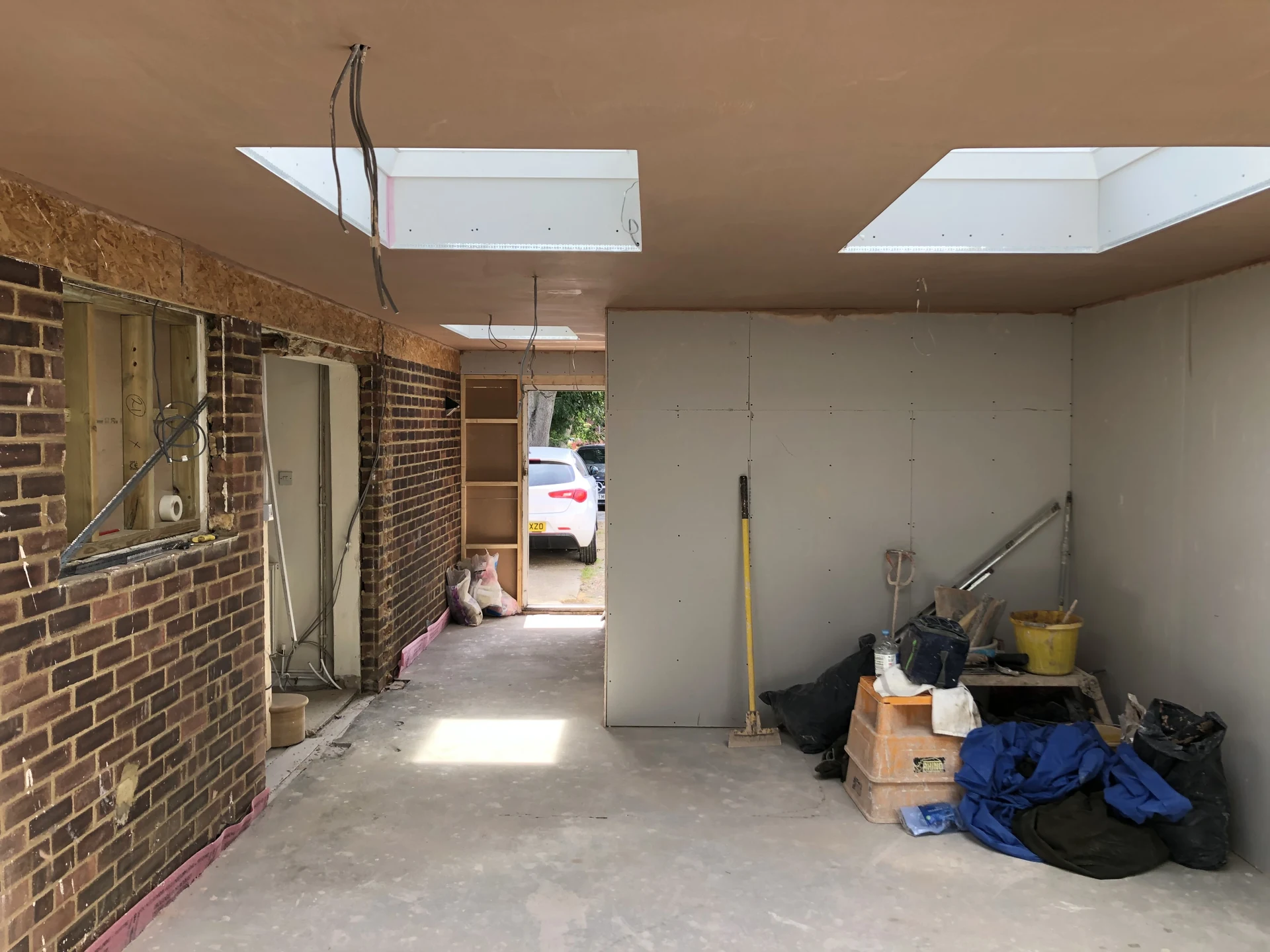
Boarding walls and ceilings
Plasterboard is fixed to timber studs or ceiling joists, or onto masonry walls using adhesive dabs, depending on the situation. Boards are cut to fit around doors, windows and fittings, then joined and taped ready for skimming.
New stud walls
When a new stud wall is built, whether to divide a room or close off an opening, it needs boarding on both sides before it can be skimmed. This gives the wall its finished thickness and a flat surface to plaster onto.
Boarding after alterations
Removing a chimney breast, opening up a doorway, or other structural changes often leave an area that needs boarding to bring it level with the rest of the wall or ceiling before it can be skimmed to match.
Choosing board thickness and type
Plasterboard comes in a few standard thicknesses and types, chosen to suit the situation: a stud wall typically takes a different thickness to a ceiling, and moisture-resistant boards are generally used in bathrooms and other damp-prone rooms. The right choice depends on what the board is fixed to, the span between studs or joists, and whether the area is likely to get damp or steamy.
Taping and jointing before skimming
Once boards are fixed, the joints between them are taped and filled before a full skim coat goes over the top, so the finished wall or ceiling reads as one continuous flat surface rather than showing the board edges. Screw heads are also filled at this stage, and any gaps around the edges of a new stud wall are made good before the finishing plaster is applied.
Boarding after a chimney breast removal or wall alteration
Removing a chimney breast or knocking through an opening often leaves an area that needs new plasterboard to bring it level with the surrounding wall. This is a common piece of follow-on work after building alterations, and the boarding is fixed and finished to match the surrounding wall height and surface so the join between old and new disappears once it's skimmed.
Planning new stud walls
A newly built stud wall needs boarding on both faces before it can be finished, with noggins or extra timber added at the frame stage wherever something heavy, like a radiator bracket or wall cabinet, will need fixing to later. Getting this noted before boarding goes up avoids having to cut into a finished wall afterwards to add extra support.
Fixing boards to different backgrounds
Plasterboard is fixed differently depending on what it's going onto: screwed directly to timber studs or joists, fixed to metal stud framework, or dot-and-dab adhesive used to bond boards straight onto a masonry wall. The right method depends on the wall or ceiling construction, and on whether the boarding is for a new stud wall, a ceiling, or dry-lining an existing solid wall.
Insulation and boarding together
Boarding is sometimes combined with insulation, particularly on external walls or in loft conversions, using insulated plasterboard that includes a layer of insulation bonded to the back of the board. This is worth considering at the planning stage of a job, since it affects wall thickness and the fixings needed, more than it changes the finishing and skimming process itself.
Services hidden behind the boards
Boarding closes up spaces that may contain cables, pipework and insulation. Any work to those services should be completed and checked by the appropriate trade before the surface is closed. Take photographs of concealed service positions where helpful, and make sure the people involved agree the sequence of work.
If you plan to hang shelving, a basin, a heavy mirror or a wall-mounted cabinet, raise this before the boards are fitted. The board surface alone may not provide the support needed. Suitable backing or framing can be planned while the space is open, rather than cutting into a newly decorated wall later.
Matching an altered area to the existing room
A new section should be considered in relation to the depth of the neighbouring surfaces. The board, fixing method and finishing coat together determine its final level. Door linings, skirting and existing wall edges can make even a small difference in thickness noticeable.
A photograph of an opened-up wall is useful, but the condition of the framing or masonry may still need checking in person. Mention whether your enquiry is for boarding only or boarding followed by skimming, so the finished stage of the proposed job is clear.
Questions homeowners ask
Does plasterboarding include the skim finish as well?
Plasterboarding itself is the boarding stage; skimming is usually carried out afterwards to give the smooth finished surface. The two are often done as part of the same job.
Can plasterboard go straight onto a brick wall?
Yes, plasterboard can be fixed to masonry using adhesive dabs, as an alternative to boarding onto timber studs.
Do you board ceilings as well as walls?
Yes, plasterboarding covers both walls and ceilings, including overboarding an existing ceiling, which is covered in more detail on the ceilings pages.
I've had a chimney breast removed, do I need boarding?
Usually yes. The opened-up area typically needs boarding to bring it level with the surrounding wall before it can be skimmed to match.