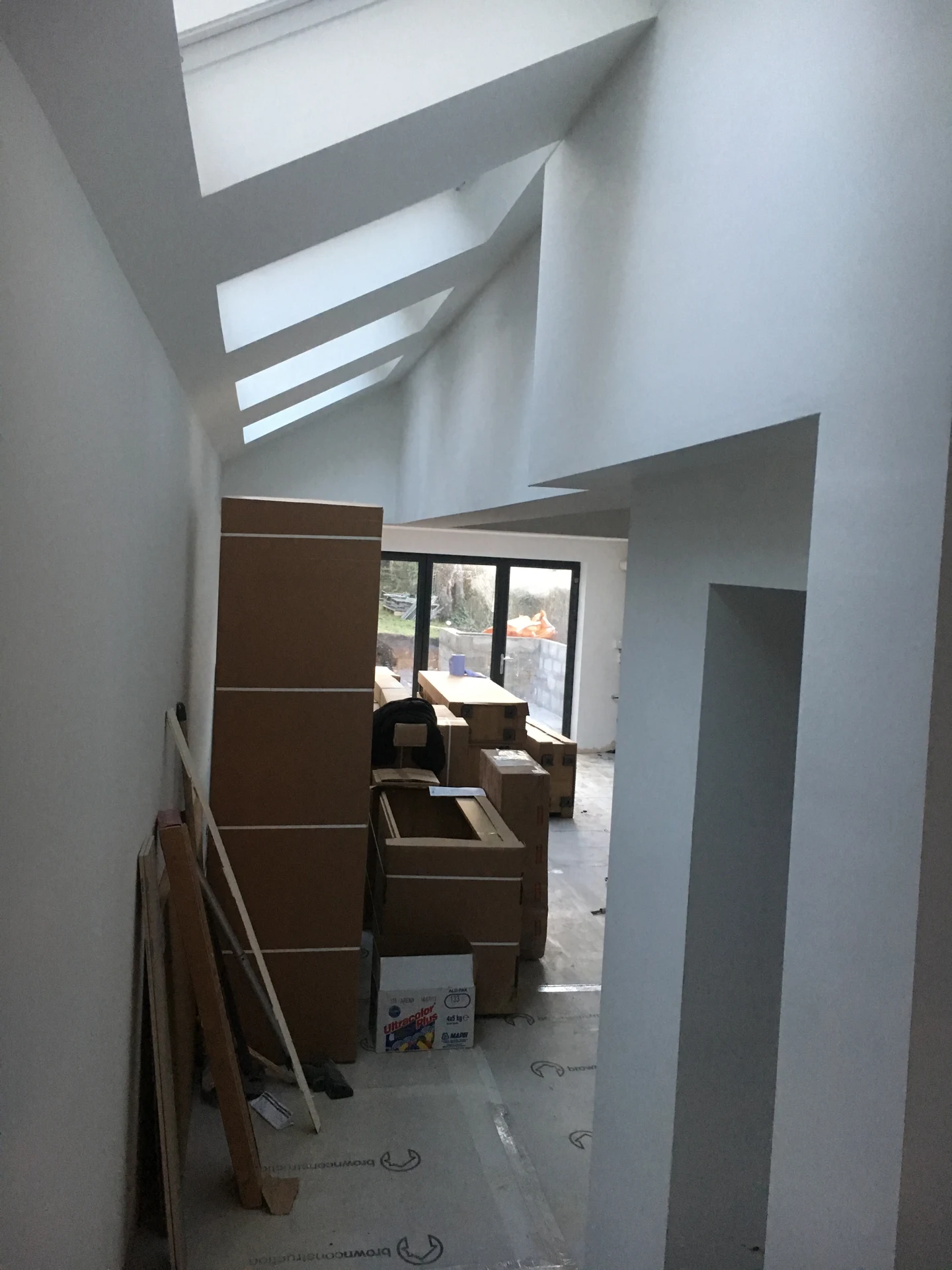
Set out the rooms, not just the floor area
This commuter town beside Knole Park has an older centre, Victorian and Edwardian houses and later family homes. That range allows for very different enquiries: a period bedroom with retained trim, a changed kitchen in a later house, or a ceiling in an upstairs landing. Give each space its own short description.
A room list is more useful than an unexplained total area. Note whether you want walls, ceilings or both, and distinguish damage from planned alterations. If one room is ready now but another still needs electrical work, say so. That information helps keep finishing work separate from changes that remain unfinished.
The family kitchen example
Removing units can reveal strips of bare background, old fixings and several layers of decoration. Before assuming that the visible gaps only need filling, consider how the finished surface will meet the units or splashback that are staying. Include these boundaries when describing plastering repairs.
Where a new boxed section or partition is part of the change, plasterboarding may be relevant. State whether that lining already exists or is included in your enquiry. A quote request that says only 'skim the kitchen' can miss the background work needed before a finishing coat is suitable.
An older bedroom is a different task
For a Victorian or Edwardian room, wallpaper removal may reveal a wall that is uneven but sound, or plaster that is no longer attached properly. Those conditions call for different discussions. A skim can refresh a suitable face; replacing failed material is a more extensive plastering task.
Retained picture rails and skirting affect the boundaries of new work. Explain what stays and what will be removed. Check with the council before changing listed interiors, and ask about conservation restrictions where relevant.
Give ceilings their own line on the list
The ceiling may need a different approach from the walls below it. A later house with an older textured finish raises questions about safe preparation and the existing background. Older artex can contain asbestos, so seek advice before disturbing it and do not sand the texture down yourself.
For a plain ceiling, describe any cracking, staining or sagging rather than simply asking to hide it. An unresolved leak needs attention before finishing work. Where a new lining is being considered, ask about the distinction between overboarding, replacement and skimming instead of treating those terms as equivalents.
Remember the rendered elevation
An outside wall may need a separate rendering enquiry while internal work is being planned. Provide an overall view and identify where the render is cracked, missing or coming away. Visible damage alone does not establish the cause, so mention any known water entry or repeated deterioration.
Contact details for a local quote
Sevenoaks is about 20 miles west to north-west of Headcorn. The drive is roughly 40 to 45 minutes depending on traffic, within the business's coverage of up to 25 miles. Stephen is fully qualified and insured, with 25 years' experience.
Phone 07852 191811 or complete the free quote form using your name, phone and postcode. Add your room list in the optional message and have photos ready for the discussion. Opening hours are Monday to Saturday, 7:30am to 6:30pm.
Questions homeowners ask
What should a TN13 or TN14 enquiry include?
Give the full postcode, not only the district, then list the rooms and surfaces involved. Explain whether each room is ready for plastering or still awaiting alterations.
Is a house near Knole necessarily treated as a period project?
No. The individual building's construction, condition and retained features matter. Being near the park does not establish the materials inside a particular house.
Can I include a kitchen and upstairs landing together?
Yes. Describe them separately, with any ceiling work and access constraints identified. Avoid combining their requirements into a single unexplained area figure.
Should garden-side render damage be photographed differently?
Include the whole affected elevation and closer images of the damage. Mention access limitations or nearby fixed structures when explaining that part of the enquiry.