Look for a deliberately worked pattern
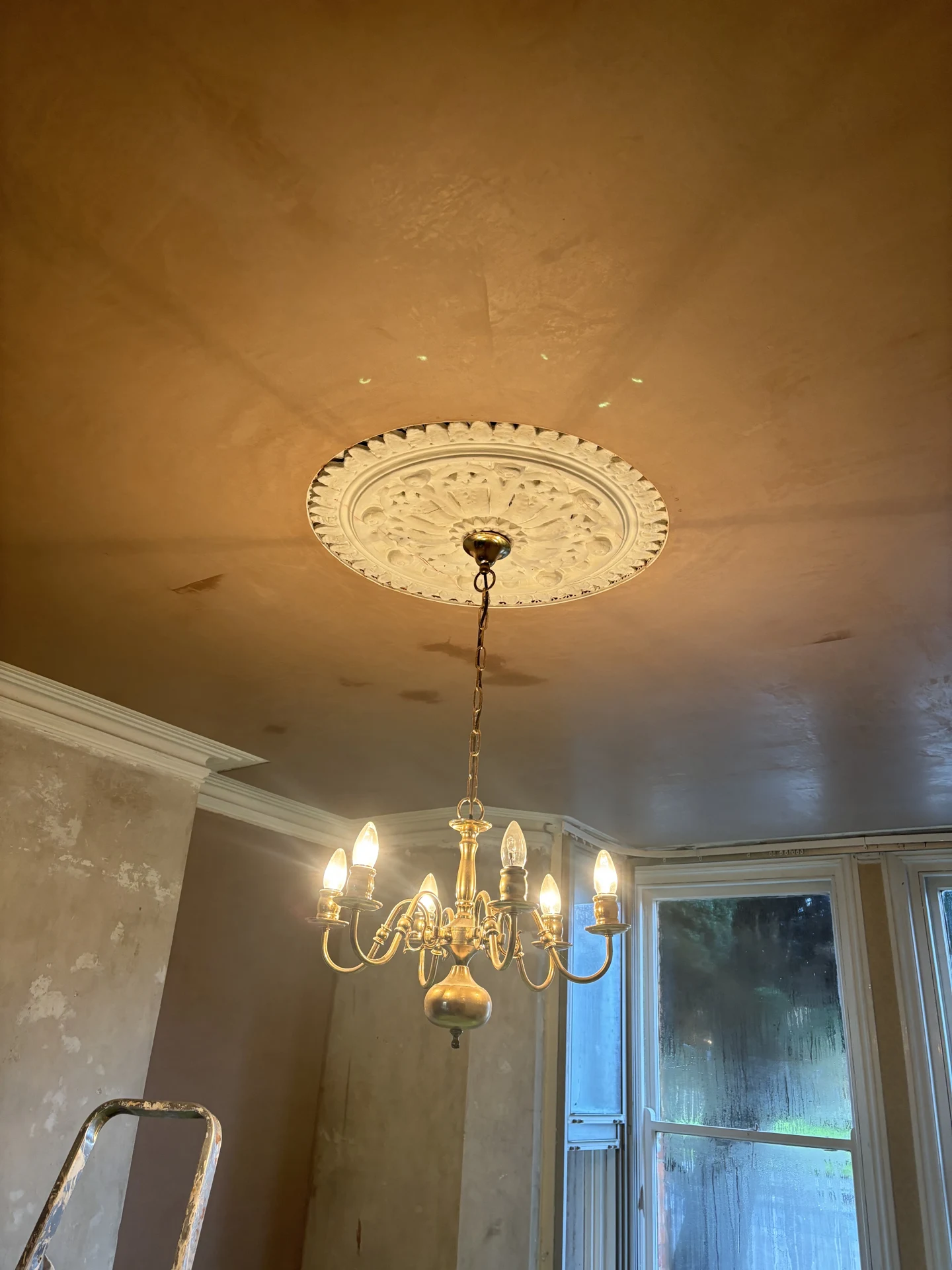
Artex is a name often used for decorative textured coatings, including other textured products. These coatings were worked while wet to create a raised design. Look across the ceiling with light falling sideways: shadows can reveal the arrangement more clearly than looking straight up beneath a central light.
You are looking for repeated marks rather than trying to identify a material by colour. Paint can soften sharp details, so an older design may look rounder and less distinct than before.
Stipple, swirls, fan and bark
Stipple has small raised points or closely spaced dabs, often spread fairly evenly across the surface. Swirls form curved loops or circular sweeps, with overlapping movements visible across the ceiling. The pattern may be regular, although hand application means neighbouring shapes are rarely identical.
A fan pattern shows repeated curved segments, rather like open fans laid beside or over one another. Bark has longer ridges and broken grooves resembling tree bark. These names describe appearances, not recipes: none tells you what is in the coating or whether it is safe to disturb.
Woodchip and popcorn can look similar
Woodchip is wallpaper containing small wood particles. It usually has scattered bumps rather than worked curves; visible paper seams or a lifting paper edge may offer a clue. Do not peel an edge to check, as an unknown coating may also be present underneath.
A popcorn style coating has an irregular, granular or clustered appearance rather than obvious brush or comb movements. The terms people use overlap, especially after repainting. A visual comparison can help describe a ceiling, but cannot reliably separate every textured product or establish its composition.
Use the building's history as supporting evidence
Textured decoration was particularly associated with the later twentieth century. A property from that period makes it a plausible original finish, while an older house may have gained texture during refurbishment. A recent extension may also have a different ceiling history from the adjoining room.
Old photographs, decorating records and information from a previous owner can help establish when a finish appeared. The construction date alone is not enough: ceilings can be replaced, patched or covered. Recent paint tells you about decoration, not necessarily the age of the layer below.
Check safely before changing anything
Some older textured finishes contain asbestos. Appearance, hardness and pattern cannot rule it in or out. Arrange sampling and testing through an accredited specialist before anyone sands, scrapes or drills a suspect ceiling; do not collect a sample yourself.
If there is damage, avoid touching the affected area and seek specialist advice. Keep any test results with your house records and share them with people planning ceiling work. Stephen's plastering service does not include asbestos testing or Artex removal.
Leave it, paint it or consider a smooth finish
An intact ceiling you like may simply be left alone. Painting retains the design rather than flattening it, but suitability and safe preparation still need considering, particularly with an older or damaged coating. Do not sand the high points as a decorating shortcut.
If you want the texture hidden, Stephen's approach is skimming over sound Artex, subject to assessment and any necessary specialist advice. Identification is only the starting point: the background must also be suitable. The linked guides explain the covering options without needing you to probe the ceiling first.
More about this topic
Can two rooms have different textured finishes?
Yes. Rooms may have been decorated at different stages, and repairs can introduce another material. Treat each ceiling's history separately rather than assuming one result describes the whole house.
Does white paint help identify the original coating?
No. White paint is used on many ceiling materials and can conceal finer details. Colour provides no reliable evidence of the underlying product.
Are straight lines across texture always wallpaper seams?
Not necessarily. Lines may relate to board joints, repairs or the way a design was applied. Record what you can see without opening the line.
What should I photograph to explain an unfamiliar pattern?
Take an overall room view and a zoomed picture from the floor with the pattern lit from the side. Avoid ladders or touching the surface just to obtain a closer image.