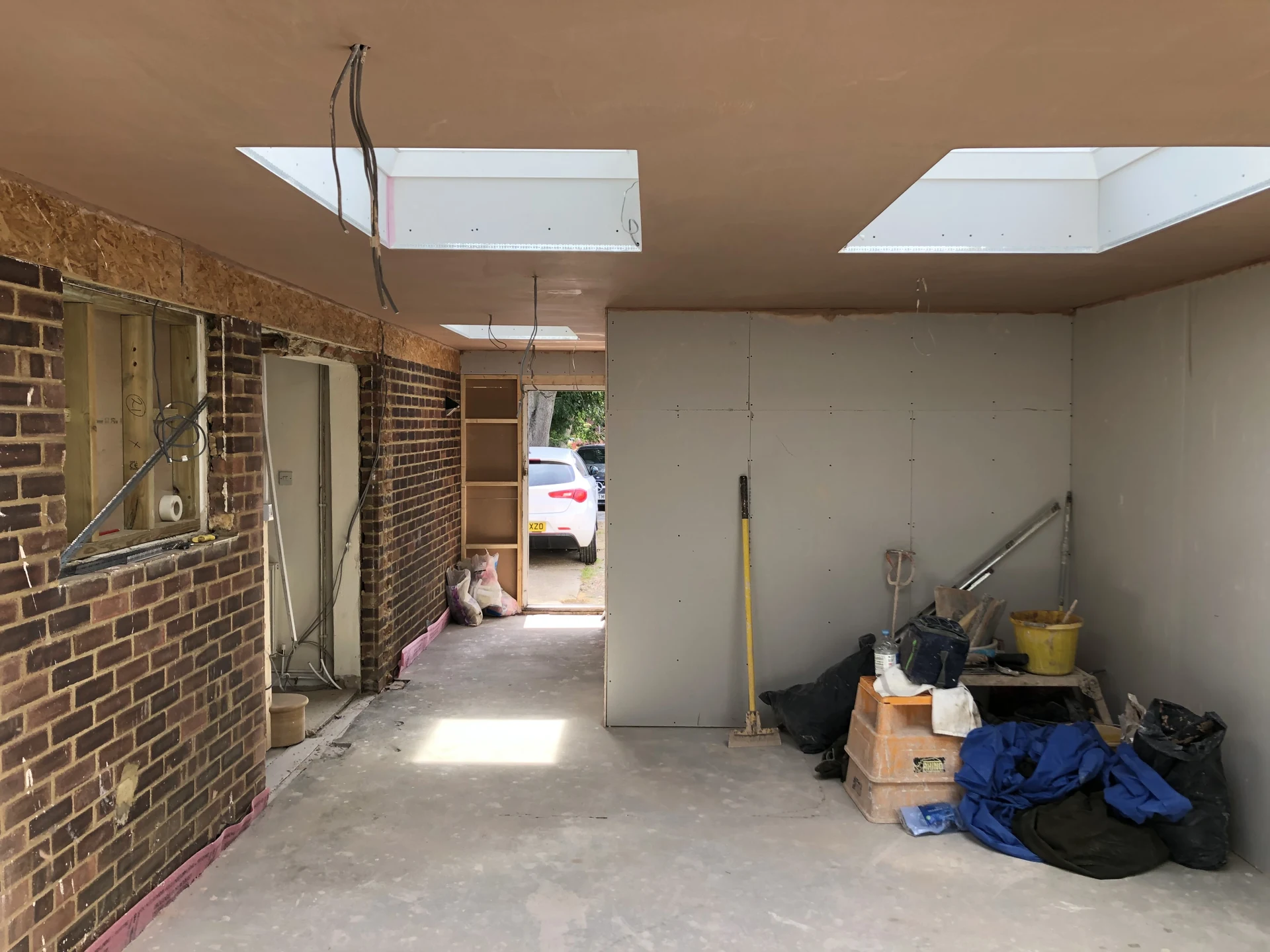
Where adhesive fixing makes sense
Older brickwork and uneven blockwork can provide a useful background for this method, provided they are dry, stable and capable of holding the adhesive. The boards are aligned to form a new plane rather than following every hollow in the masonry. Very large variations may call for another approach rather than increasingly thick dabs.
It is often chosen as a quicker dry trade compared with building up several wet coats across the wall. That does not mean immediate decorating: adhesive, joint treatments and any skim still need to dry. Stephen can discuss whether boarding or replastering better suits the room.
Preparing what will be hidden
Loose plaster, dusty material and unreliable surface coatings cannot simply be trapped behind the boards. The background needs checking and preparing so the adhesive bonds to something sound. Absorbency also matters, since a thirsty background can affect how the adhesive behaves.
Active damp is a reason to stop, not cover up. A leak or other moisture source needs attention from the appropriate trade before boarding is considered. An old wall should not be assumed dry just because its exposed face feels dry to the touch.
Allowing for the new wall face
Boarding moves the finished surface into the room. That affects window reveals, door linings, skirting boards and the meeting point with neighbouring walls. These details need considering together so a flat new wall does not leave awkward edges around existing joinery.
Clear the wall and explain which fittings are staying. Access to the full height helps with setting out, cutting boards and keeping joints and corners properly supported. Agree whether skirting will be removed and refitted rather than expecting the board edge to disappear behind it.
Sockets and things you want to hang
Electrical boxes must suit the finished wall depth. Ask the electrician to arrange safe isolation and any alterations before the boarding closes off access. Socket fronts should not be left recessed behind the new surface or pulled forward on unsuitable screws.
Heavy cabinets, radiators and large brackets need a fixing plan. Adhesive dabs do not turn the board into solid masonry. Suitable fixings may need to pass through the lining into the wall, with support across the gap. If the proposed loads cannot be supported properly, another lining arrangement may be needed.
Choosing the finished surface
After fixing, boards can receive a full skim, with joints reinforced as required, to give a continuous plaster surface. Another possible finish is taping and jointing suitable boards, treating joints, corners and fixing points without plastering the entire face. Confirm the intended finish when discussing the quote.
The choice affects board edges, preparation and decorating. Neither approach should leave untreated joints under paint. Let the completed work dry naturally with suitable ventilation before following the paint manufacturer’s instructions for a new surface.
Questions homeowners ask
Will dot and dab straighten a wall that leans?
It can correct modest differences in the surface, but it is not a repair for movement or unstable masonry. A leaning wall needs its condition understood before a lining method is selected.
Can I mark shelf positions before the boards go up?
Yes. Share the intended positions and likely loads while the masonry is accessible. Photographs and measurements can help the person installing the fixings avoid hidden services later.
Does the gap behind the board mean I can route cables anywhere?
No. Cable routes and protection remain matters for the electrician. The space behind a lining is not permission to run services without regard to electrical requirements.
What should I send for a dot and dab enquiry?
Send a room view, closer pictures of exposed masonry and details of sockets and planned wall fittings. WhatsApp photos to Stephen on 07852 191811 to start a free quote enquiry.