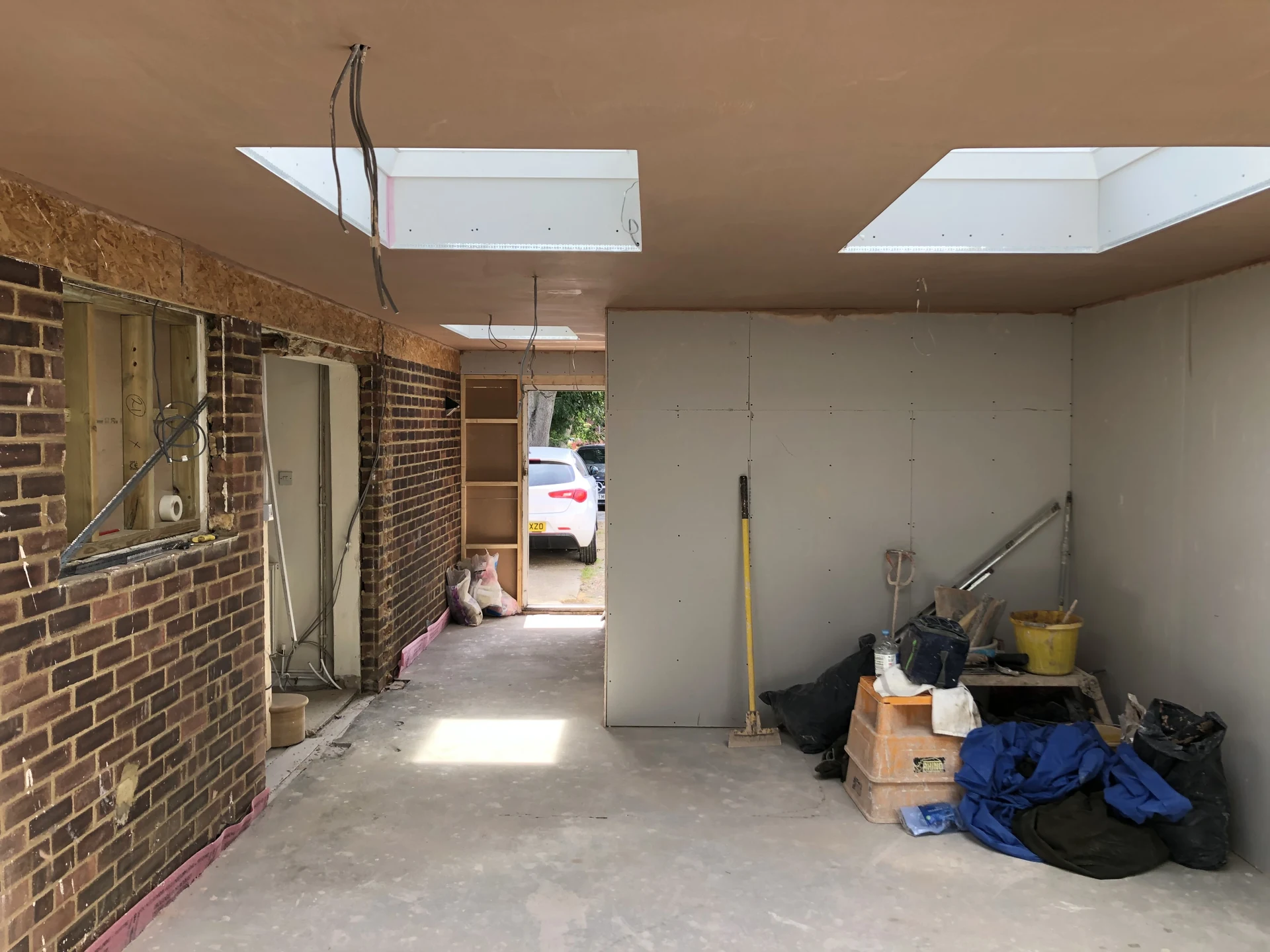
What the two terms describe
Wet plaster is applied in a workable state and forms a coating on a prepared background. Depending on the system, there may be a backing layer and a finer finishing layer. Skimming usually refers to the thin finish rather than rebuilding the whole depth of a damaged wall. These distinctions matter when comparing a quote for a surface renewal with one for more extensive work.
Dry lining generally uses plasterboard to line a wall or form the face of a partition or ceiling. The boards are fixed using a system suitable for the background and purpose. They establish a surface, but joints, corners and the final decorative treatment still need to be specified. Calling something dry lined does not explain every step required to make it ready for paint.
The options overlap because plasterboard can be skimmed. In that case the board is the lining and wet plaster provides the continuous finish. It is not a contradiction to include both plasterboarding and skimming in one project; they perform different jobs within the same build-up.
Old solid walls need a background-led decision
On an existing solid wall, first establish what is already there and whether it remains firmly attached. Sound plaster may be retained and prepared for an appropriate finish. Widespread loose material might require a more substantial approach. Neither a skim nor a lining should be treated as an automatic cure for a background whose condition is uncertain.
Traditional walls can have particular material and moisture requirements. Where lime plaster or older construction is present, compatibility deserves attention before a modern system is selected. The broad distinction between old and new is not enough: alterations may have introduced several materials into the same building over time.
Damp needs its cause addressed rather than concealed. Adding a board or fresh coating in front of a wet wall can hide a symptom without resolving it. Describe staining, previous leaks or recurring deterioration when enquiring, and obtain appropriate investigation where necessary.
New stud walls and ceilings
Plasterboard commonly forms the lining of stud partitions, providing faces to the framing. The choice of board and fixing arrangement needs to suit the required construction. A homeowner should not assume that all boards have the same purpose or that a change of lining alone establishes a particular fire, moisture or acoustic performance.
Once the boards are in place, their joints and edges need a defined finishing method. Skimming is one option for producing a continuous plaster surface. The relevant proposal should explain what is included rather than stop at the word boarding. Ask how corners, openings and junctions with the existing room will be treated.
Ceiling boarding also depends on the supporting construction. Overboarding an existing ceiling is different from fitting a lining to new framing. The condition and attachment of what is already overhead must be considered. A smooth decorative face cannot compensate for inadequate support or an unresolved problem behind it.
Uneven surfaces and the space within a room
Where a wall is uneven, the approach may involve a suitable plaster build-up or a lining system that establishes a different plane. Either can change details around openings and edges. Discuss reveals, sockets, skirting and retained features so the chosen method makes sense beyond the centre of the wall.
A lining can affect usable room dimensions, while plaster depth also varies with the background and intended finish. There is no single allowance that applies to every room. Ask how the proposed work will meet adjacent surfaces and what happens where new and existing finishes join.
Consider whether the aim is an entirely renewed surface or a repair that leaves the wider wall in place. A handful of damaged areas does not always justify relining a room. Conversely, repeated repairs over an unsuitable background may not be a sound long-term basis for decoration. Assessment should guide that distinction.
Mess, preparation and drying
Wet plastering involves mixing and applying material, while boarding involves handling, cutting and fixing sheets. Both create preparation and clean-up needs. Dry lining should not be read as a promise of a dust-free job, just as wet plaster does not describe the exact disruption of every project.
If boards are skimmed, the plaster finish still has to dry before appropriate decoration. Other finishing materials also have their own preparation instructions. Ventilation, depth, room conditions and the background influence drying; the word dry in dry lining does not remove those considerations from the finishing stage.
Avoid choosing a system solely on an assumed number of days before painting. Discuss the actual specification and read the drying guidance alongside the paint manufacturer’s instructions. If decorating or other work is being planned, make the sequence part of the enquiry rather than relying on a generic internet timetable.
Choosing the appropriate specification
Describe the existing construction if you know it, together with the changes intended for the room. Tell Stephen whether the surfaces are old plaster, exposed masonry, new framing or existing boards. Unknown details are worth stating as unknown; guessing a background can lead to comparing proposals that do not answer the same problem.
For new linings, explore the plasterboarding service. For renewing a sound face, read about skimming; for widespread failing material, consider the replastering guidance. Where the project involves a ceiling, use the ceiling pages to understand that its support and existing condition form part of the discussion.
The best answer may combine methods, with boarding in a new area and plaster work on an existing one. What matters is a coherent specification for the room and clear treatment at their junction. Request a quote around those requirements rather than asking for a universal winner between wet plaster and boards.
More about this topic
Can a room use both dry lining and wet plaster?
Yes. Boards can create a lining which is then skimmed, and separate parts of a room may use different suitable methods.
Does dry lining mean no drying before paint?
No. A skim or other finishing treatment still needs its material-specific drying and preparation considered before decoration.
Is plasterboard the answer to every uneven solid wall?
No. The wall’s condition, moisture, compatible materials and junction details all influence whether a lining is appropriate.
Are all plasterboard types equivalent?
No. Board and system choices depend on the construction and its requirements; do not assume an unspecified board provides a particular performance.
What detail should I ask about where old and new surfaces meet?
Ask how the junction, final plane and retained trim will be treated, so the method works at the edges as well as across the main face.