Read the room before stripping it
Royal Tunbridge Wells is a spa town known for the Pantiles, with Georgian, Regency and Victorian villas and terraces among its established buildings. Large conservation areas are part of that setting. A flat within an older converted house, for example, may contain a combination of original details and much later partitions.
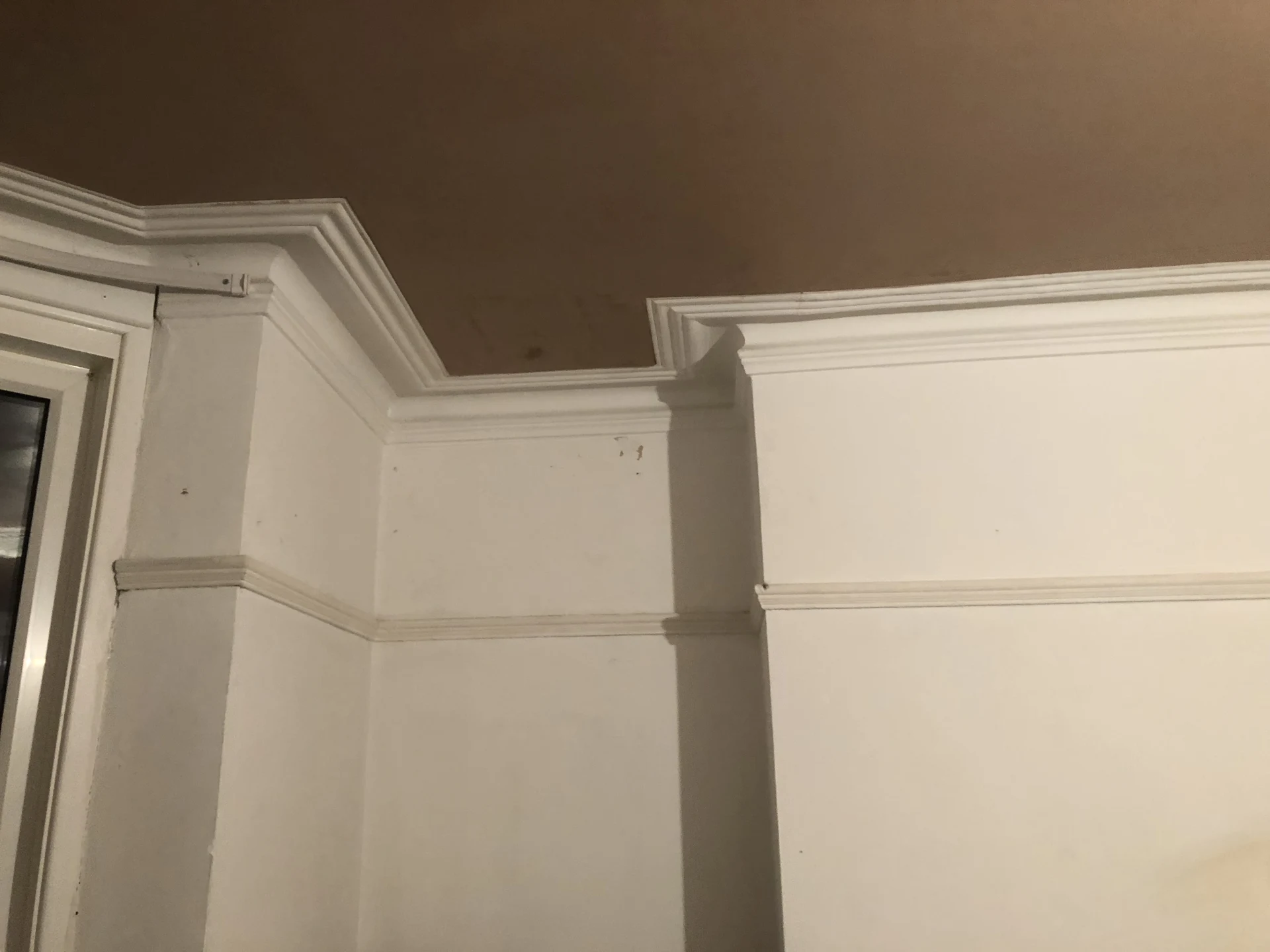
Before taking down wallpaper or ceiling decoration, decide what you intend to retain. A moulded ceiling edge, a deep reveal or an irregular wall can influence how new plaster should meet the old work. Flatness is not the only consideration where a room's existing character is important.
Check with the council before relevant work in a conservation area or listed building. Listing can affect internal work, not only the outside. Where traditional plaster or other historic fabric is present, seek advice on suitable treatment rather than assuming a standard modern covering is appropriate everywhere.
Three different edges to think about
First, consider the edge of any damaged plaster. If the surrounding material is firm, a local repair may be appropriate; if deterioration extends further, the working area may need to change. Do not rely on the visible hole alone to decide the size of the job.
Second, look at the wall-to-ceiling line. Coving can define that junction in a plain room, while an existing cornice may be something to preserve rather than replace. Say which you mean. New coving is not automatically a like-for-like answer to damaged historic ornament.
Third, include the edges around doors and windows. A skim adds a finishing layer to a suitable surface, so existing trim and narrow reveals deserve consideration. Photos taken from an angle can help explain those relationships, alongside an overall picture showing the proportions of the wall.
For a later family house without decorative features, the priority may instead be straightforward skimming after stripping wallpaper. The same questions about soundness still apply. Several old filler patches do not necessarily mean the whole background has failed, and one tidy painted face does not prove it is sound underneath.
Ceilings warrant particular care in older rooms. Report sagging, recurring cracks or past water damage separately from a wish for a smooth finish. If there is a textured coating, obtain advice before disturbing it because older coatings may contain asbestos. Avoid sanding or scraping as exploratory preparation.
Make a clear enquiry from the western end of the coverage area
From Headcorn, the journey is west to south-west, about 16 miles and roughly 35 to 40 minutes depending on traffic. Stephen covers up to 25 miles from his base.
Call 07852 191811 to describe the room, or request a free quote through this page. Enter your name, phone and full postcode. The optional message is a useful place to mention a converted flat, retained mouldings or uncertainty about a ceiling, without having to choose a trade term first.
Prepare photographs that show both detail and context for the discussion. A close view of a crack is useful, but a wider view helps locate it against openings and retained features. Do not remove a suspect coating just to obtain a clearer photograph.
Questions homeowners ask
What should I flag about a flat near the Pantiles?
Mention any listed status, retained features and shared access. Its location is useful context, but the actual building and proposed changes determine what checks are needed.
Does living in a conservation area rule out skimming?
Not automatically. Check the position with the council for your building and proposed work, particularly where listing or historic internal fabric is involved.
Can a villa ceiling be treated as ordinary plasterboard?
Do not assume that it is plasterboard. Explain any known construction and visible distress; the lining and its condition need establishing before choosing the work.
How do I describe coving I want to leave intact?
Say that it is to remain and show how it meets the affected wall or ceiling. Include its corners and any existing damage in your photographs.