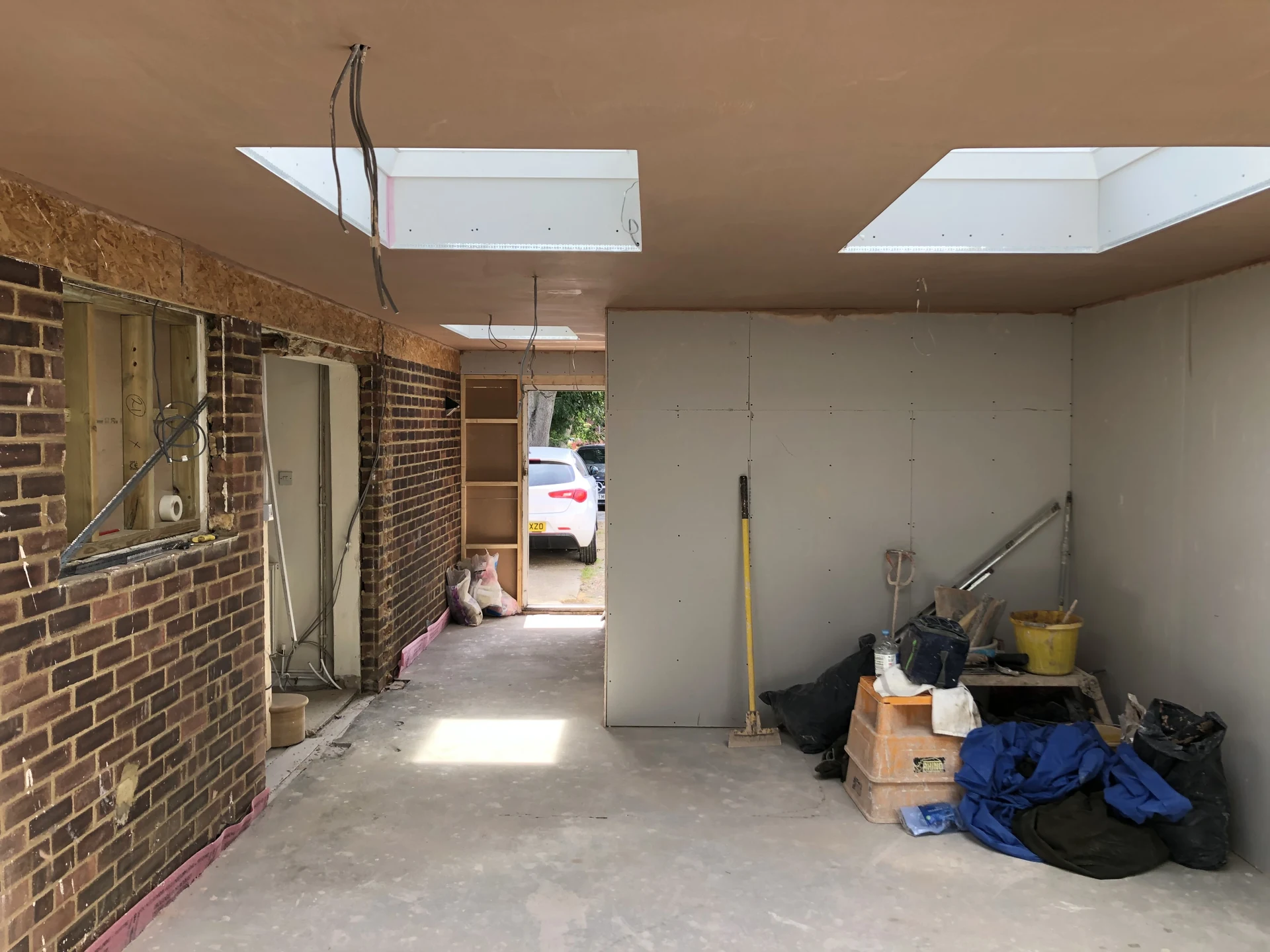
Why the type of board matters
From the front, most plasterboard looks much the same once it has been skimmed. The difference sits inside the board: the gypsum core can be made denser, reinforced with glass fibre, treated to resist water or bonded to a layer of insulation. Each change gives the board a specific job, and each one usually adds weight and cost compared with a standard sheet.
The usual mistake is treating every board as interchangeable. A standard board fixed behind a shower, or an ordinary sheet used where building regulations expect a fire rating, can mean ripping the wall out later. On the other hand, paying for specialist board throughout a dry bedroom adds expense without any real benefit. The right answer depends on the room, what sits on the other side of the wall and what the work has to satisfy.
Standard plasterboard
Standard board is the everyday sheet used for most walls and ceilings in living rooms, bedrooms and hallways. It is usually grey or ivory on the face, comes in a few common thicknesses and takes a skim coat well. Thinner boards are lighter and easier to handle, while thicker boards are stiffer and help on ceilings where the joists are spaced further apart.
For a straightforward room with no special needs, standard board fixed properly and finished with a skim is normally all that is required. Spending more only makes sense when the room or wall has a particular demand placed on it.
Moisture resistant plasterboard
Moisture resistant board, often green on the face, has a core treated to take up less water. It suits bathrooms, en suites, utility rooms and kitchen walls that see regular steam. It handles humid air better than standard board, but it is not waterproof. It is not a substitute for proper tanking or a cement based backer board in an area that gets wet directly, such as inside a walk in shower.
A common problem is fixing green board in a shower enclosure and tiling straight onto it without any waterproofing. Over time water finds its way through the grout and the board softens behind the tiles. If you are planning a wet area, ask the tiler or bathroom fitter what backing they need before the plasterer starts, so the right board goes in the right place.
Fire rated plasterboard
Fire rated board, often pink or red, has glass fibre and additives in the core that help it hold together for longer in a fire. It is commonly needed on the ceiling and walls between an integral garage and the house, around some loft conversions and staircases, and in other places where building regulations set out a level of fire protection.
The rating comes from the whole build up, not just one sheet. The number of layers, the board thickness, the fixings and the way joints and gaps are filled all play a part. If your job falls under building regulations, your building control officer or designer will say what is required, and it is worth confirming this before work begins rather than assuming.
Acoustic and soundproof plasterboard
Acoustic board, often blue, is denser than standard board, so it reduces airborne noise such as voices and televisions passing through a wall or ceiling. It is popular on walls shared with a neighbour, between bedrooms and under a room used as an office or playroom.
Board alone rarely makes a wall soundproof. Noise travels through gaps around sockets, through the floor void and along the structure, so the best results come from combining dense board with sealed edges, insulation in the stud cavity and sometimes resilient bars or a separate frame. Impact noise, like footsteps on the floor above, is harder to treat from below and may need work to the floor itself. Being realistic about what the board can achieve saves disappointment.
Insulated plasterboard
Insulated board has a layer of foam bonded to the back. It is often used to line cold external walls, particularly solid walls in older houses, and in some loft and extension work. It adds warmth without building a separate frame and insulation layer, though it does take a little space from the room.
On older solid walls, moisture needs careful thought. Fixing an insulated board straight over a damp wall can trap that moisture, so any damp problem should be found and dealt with first. Window reveals, sockets and skirting boards also need planning, because the wall surface moves forward by the thickness of the board.
Fixing methods and the skim finish
Boards can be screwed to timber or metal studs, fixed to ceiling joists, or stuck to masonry walls with adhesive dabs, a method known as dot and dab. Whichever method suits, the joints are then taped and the surface is skimmed, or the joints are filled and sanded for a taped and jointed finish. A skim gives a harder, more even surface that most homeowners prefer for decorating.
Specialist boards are heavier, so ceilings may need closer fixings, and acoustic board in particular can be a two person lift. Moisture resistant and fire rated boards both take a skim in the usual way, so the finished room looks the same whichever board is behind it.
Mistakes to avoid
Mixing board types on one wall without a reason, leaving gaps at the edges of fire or acoustic walls, fixing boards over damp masonry, and skipping waterproofing in wet areas are the faults that cause most trouble later. Another frequent issue is ordering the wrong thickness, which leaves lips where new board meets existing plaster.
It also pays to think about what will hang on the wall. Heavy kitchen cupboards, radiators and televisions need timber noggins or suitable fixings planned before the boards go up.
When to call a professional
Small patches of standard board are within reach of a capable DIYer, but full rooms, ceilings, fire separation and anything covered by building regulations are better left to a plasterer. Boarding a ceiling is heavy, awkward work, and a poor fixing can cause cracking along the joints for years. Stephen O’Brien is Level 2 qualified in solid plastering and British Gypsum certified, and he fixes plasterboard and skims it for homeowners within up to 25 miles of Headcorn. Tell him what the room is used for and what sits beyond each wall, and he can talk through which board suits before quoting.
More about this topic
Is green plasterboard waterproof?
No. Moisture resistant board copes better with humid air, but it is not designed to be soaked. Areas that get wet directly, such as inside a shower, need proper waterproofing or a suitable backer board.
Do I need fire rated plasterboard in a garage?
Walls and ceilings between an integral garage and the house usually need fire protection under building regulations. Check the exact requirement with building control or your designer before work starts.
Will acoustic plasterboard stop all noise from next door?
It helps with airborne noise such as voices, but it works best alongside insulation and well sealed edges. Footsteps and other impact noise are harder to stop with board alone.
Can you skim specialist plasterboard?
Yes. Moisture resistant, fire rated and acoustic boards are all normally skimmed in the same way as standard board, so the finished wall looks the same.
Is insulated plasterboard a good idea on an old solid wall?
It can be, but only once any damp has been dealt with. Fixing insulated board over a damp wall can trap moisture behind it.